
An interview with Itzel González, founder of El Conejo en el Faro, a Philadelphia-based cultural initiative inspired by the cineclub tradition across Latin America.
By Gabriela Watson-Burkett and Claudia Ceballos. On November 16, 2026. Translated by Ana Flavia Orosco Wong.
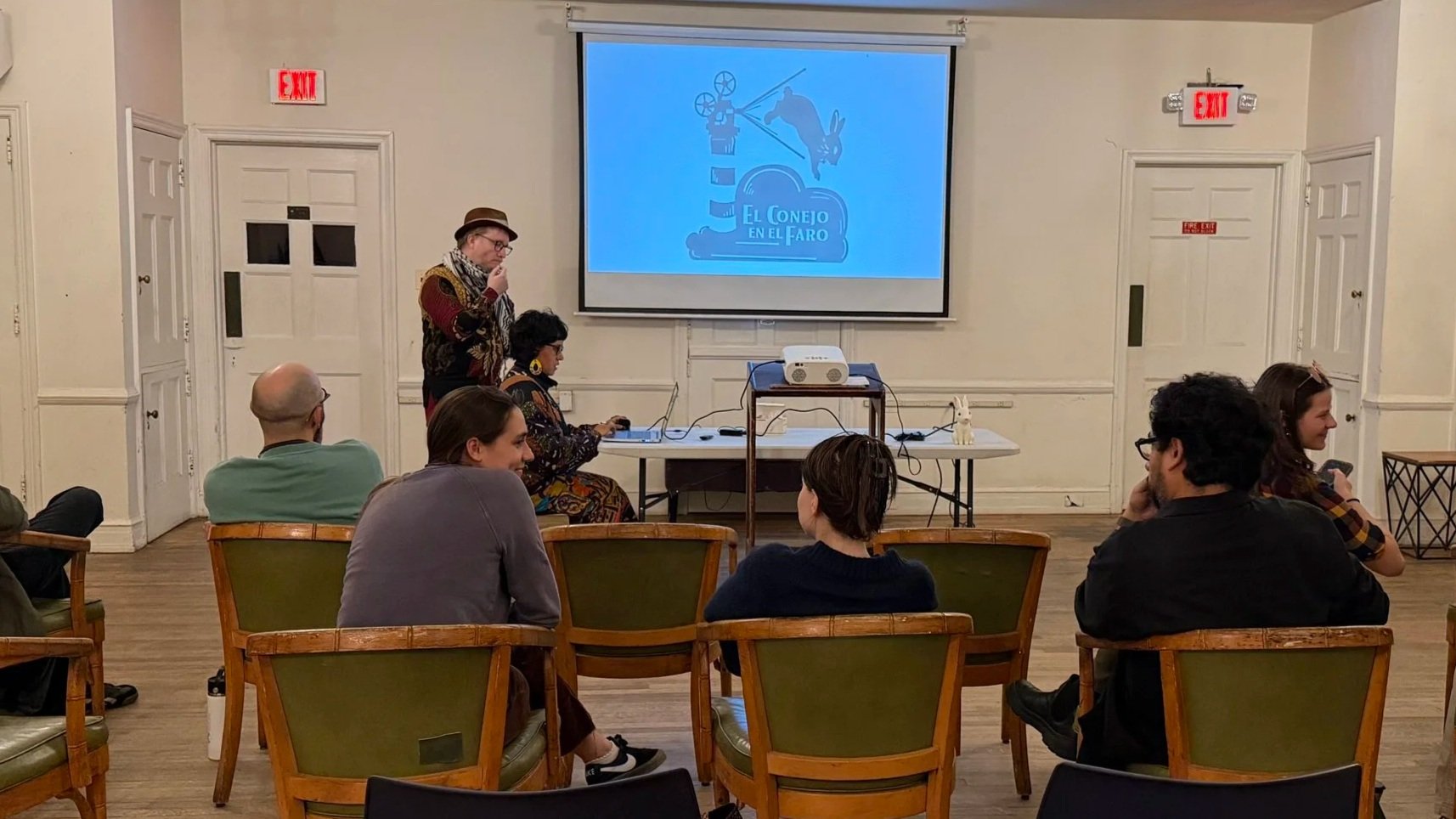
For Itzel González, cinema is more than entertainment. It is a way to bring people together, spark conversations, and connect communities through stories from across Latin America.
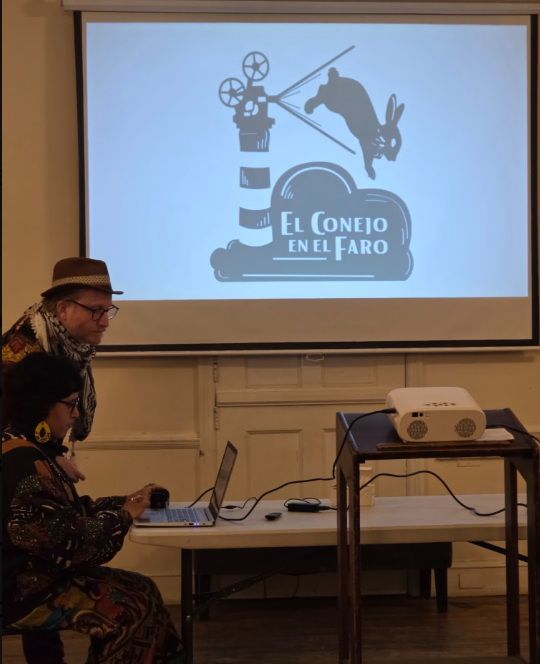
El Conejo en el Faro, before the screening begins. (Photo by Claudia Ceballos/ Inti Media.)
Originally from Mexico City, González studied linguistics and Hispanic literature at the National Autonomous University of Mexico (UNAM). Since 2023, she has organized El Conejo en el Faro, a Latin American film club that has found a home in several venues throughout Philadelphia. The cineclub just ended its 2026 season at the Philadelphia Ethical Society building in Center City.
Beyond organizing free film screenings, González also shares her passion for Latin American storytelling through education. From September to October 2026, she taught Science Fiction in Latin America, a course at Fleisher Art Memorial.
Rooted in a long-standing cultural tradition across Latin America, cineclubs offer more than a place to watch films. Typically hosted in schools, cultural centers, and community spaces, these gatherings invite audiences to participate in discussions after each screening. Through collective reflection, participants explore the films' social, political, and cultural themes, exchange perspectives, and contribute to a shared sense of cultural memory.
Inti Media sat down with the Mexican curator for a brief conversation ahead of a screening of Apocalypse in the Tropics, a documentary directed by Brazilian filmmaker Petra Costa. The film examines the growing influence of evangelical Christianity on Brazilian politics, the rise of the far right, and the country's deepening political divisions.
The screening offered an opportunity to reflect on the relationship between religion and politics in Brazil and the broader implications of these developments for Latin America and beyond.
Inti Media: Itzel, tell us why you’re so passionate about film clubs.
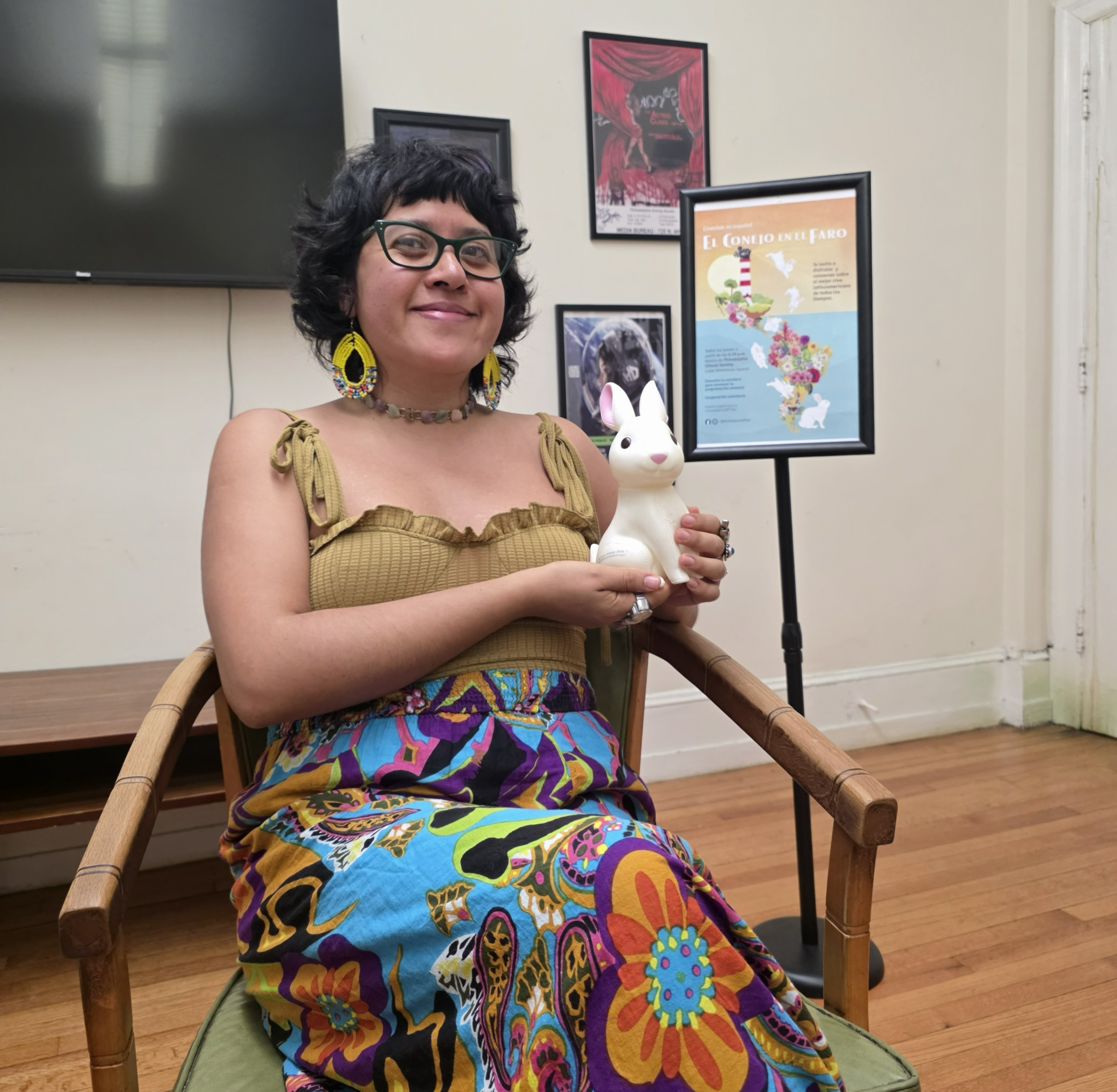
Itzel Gonzalez, creator of cultural spaces like El Conejo en el Faro. (Photo by Claudia Ceballos/ Inti Media.)
Itzel: Why? Well, I like film clubs because I think they’re something very inherent to Latin American cultures. Well, not only Latin American cultures. It’s something that’s present in many places, maybe except in the United States, and it’s something I grew up with. Maybe the first film club I attended was in my adolescence, and I thought it was a great space. Ever since I discovered film clubs, they seemed to me like spaces that were, besides a more interesting way of socializing, also a way of opening up spaces to think, and above all to think collectively. I think that’s a smart idea given the situation we’re in today: the hyper-accelerated pace of connections, and the fact that a lot of audiovisual production doesn’t have the impact it used to have in the past, because we’re also conditioned by what emerges on global platforms or by the recommendations social media gives us. Also, how good, there’s already a more drastic change in these kinds of circuits as well.
Inti Media: How do you curate the seasons or decide on which films to select for the screenings?
Itzel: Well, I generally try to think of a theme, or of films I’ve seen recently, and then I try to think of others that could tell a story around that theme. Lately, the theme has been very open over these past few months, but, for example, at Fleischer, the curation revolves around Latin American science fiction. So it has been a research effort to find out what science fiction work has been made. We also started this year with a cycle dedicated to LGBTQ+ cinema. One of the films we saw was one of the first Brazilian LGBTQ+ films, O Menino e o Vento. So there’s always a lot, a lot of research involved.
Inti Media: And what are the conversations like after the films?
Itzel: Well, at the start of the screening I try to give a brief presentation about what we’re going to see, and then we watch the film. I try to recall some of the main points that came up, and I open the conversation to the audience. The audience decides where the conversation goes. It’s very organic, and I don’t have to force things much; the conversations simply happen.
Inti Media: Was there a conversation that caught your attention, that you really liked, that was especially fruitful?
Itzel: Well, for me all the conversations have been fruitful. I think the film club has also let me meet people in the city with really interesting ideas, who can analyze the images and ideas represented in cinema in a very, very complex way. Every film surprises me with what people say. Maybe, the year before last, I did a documentary [screening]... there was a cycle at El Conejo en el Faro about migration. At one of the documentaries, I remember one of the attendees brought a friend who was very transphobic [sic: likely “xenophobic”], and it was interesting to watch this man try to connect the ideas he was seeing in the film, and by the end of the conversation he said something like, “So they don’t come to steal our jobs.” It was a moment of revelation, because I’m sure that on his own he would never have watched a documentary like that, and on his own he would never have approached a conversation space like El Conejo either, and he would never have had the opportunity to interact with images and with other people about what he was watching. So that was an interesting moment, but in general there are always interesting situations at El Conejo. It depends a lot on the film and on what resonates with people or connects with the kinds of scenes they’re watching.
Inti Media: What film are we going to watch today, and why? What is this film’s importance at this moment?
The film we’re going to watch today is Apocalypse in the Tropics by Petra Costa, from 2024. Its importance at this moment is that what’s happening in Latin America today in terms of the breakdown of democracy is incredible. Actually, I think we’ve been living with the breakdown of democracy for 100 years. So it’s important, and I find it interesting to see what the moments of intervention have been. We’ll see how the conversation develops.
Inti Media: What would you like to talk about? What points?
Itzel: Well, I’d like to talk about, maybe I’ll mention a bit about the effort to counter the Liberation Theology movement in Latin America, and how, with the rise of evangelicalism, other links have been made with the far right in Latin America. But we’ll see.
Inti Media: Is there anything else you’d like to say?
Itzel: Well, there are a few more sessions this year, probably until just before Thanksgiving. We have screenings every Thursday here at the Ethical Society. There are also a couple of screenings left in the special Latin American science fiction cycle at Fleischer, which are on Tuesdays at 6 p.m. And there’s also a Day of the Dead special on November 6 at 6 p.m. at Fletcher Art Memorial. So I invite you all to come to the rest of the screenings. You’re welcome, and thank you.
Help keep the 2027 season of Latin American cineclub tradition alive in Philadelphia! Support El Conejo en el Faro and help bring more Latin American films, stories, and community conversations to the city in 2027.
Support the initiative by donating via Venmo to @itzelario.