
Immigrants Are The Backbone of Philadelphia’s Economy Across Sectors
Industry leaders provide tangible evidence on the talent and innovation immigrants bring to the city’s workforce
By Jensen Toussaint. Edited by Ericka Conant.
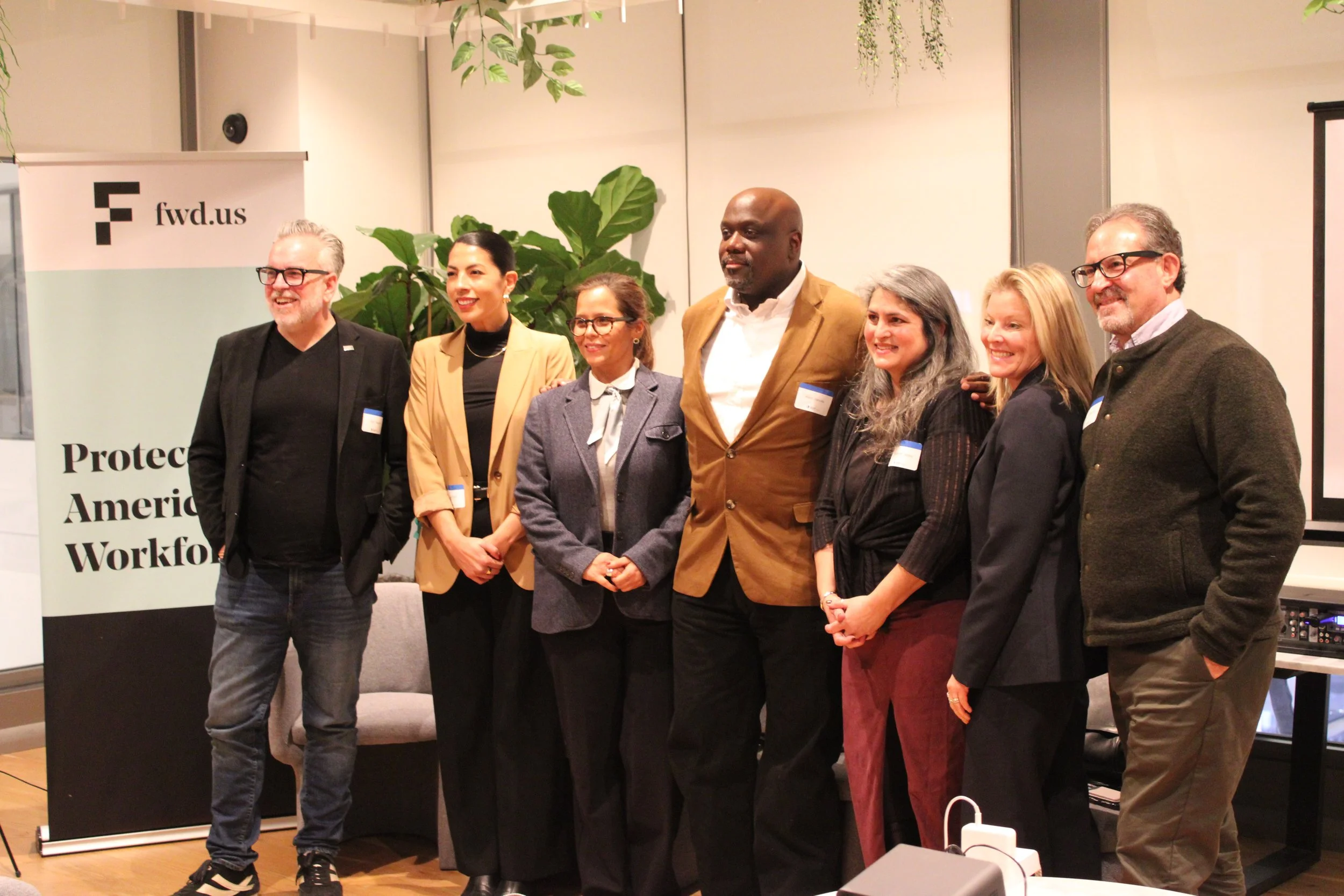
Ben Fileccia, Maria Praeli, Jennifer Rodriguez, Alain Joinville, Elizabeth Jones, Tracy Brala, and Jeff Hornstein.
(Photo by Jensen Toussaint / Inti Media)
At a moment of growing concern and challenges due to federal immigration policy nationwide, it’s important to remember just how much Philadelphia’s economy depends on immigrants.
This was the key point during a Jan. 29 panel discussion at Industrious, hosted by the Economy League of Greater Philadelphia in collaboration with FWD.us.
The discussion brought together leaders from a wide range of sectors — including healthcare, higher education, city government, small business, and hospitality.
Each panelist shared why immigrants are foundational to the city’s growth, competitiveness, and overall identity.
Innovation, healthcare, and the immigrant advantage
Tracy Brala, senior vice president of ecosystem engagement at University City Science Center, said that roughly half of the companies the Science Center has supported in the past decade were founded or co-founded by foreign-born entrepreneurs.
“And what we’re seeing is oftentimes, their co-founders are originally from the United States, and so there’s this real synergy between foreign-born nationals and US-based organizations,” she said, adding that this synergy helps to accelerate innovation.
A key local story is that of Dr. Katalin Kariko, the Hungarian-born researcher who came to Philadelphia during the 1980s and built her career at Temple University and the University of Pennsylvania (Penn). Decades later, her work on mRNA technology helped save billions of lives during the COVID-19 pandemic and ultimately earned her a Nobel Prize.
“These are the kinds of breakthroughs that happen when talent is allowed to move,” Brava said. “Immigrants are translating innovation into impact.”
At the national level, the pattern is even clearer, as nearly 50% of Fortune 500 companies were founded by immigrants or the children of immigrants.
Among these companies are Ace Hardware and Sirius XM Holdings.
At the national level, the pattern is even clearer, as nearly 50% of Fortune 500 companies were founded by immigrants or the children of immigrants.
Among these companies are Ace Hardware and Sirius XM Holdings.
Universities are in the talent business
Few institutions illustrate the risks that recent immigration policies present more clearly than Philadelphia’s universities.
Amy Gadsden, Ph.D., associate vice provost for global initiatives at Penn, put it plainly that universities are in the talent business.
“We recruit the best talent not just from Philadelphia or Pennsylvania, but from around the world,” she said. “That’s how you remain a leading research institution.”
At Penn alone, there are roughly 9,000 international students and nearly 2,000 international scholars. Together, international students contribute an estimated $1.3 billion annually to Philadelphia’s economy and support more than 6,000 local jobs.

In order to maintain its status as a leading academic and research institution, immigrant talent is paramount, says Amy Gadsden, Ph.D. of Penn Global. (Photo by Jensen Toussaint / Inti Media)
Gadsden also noted that every three international students generate roughly one job.
Contrary to a common narrative, Ivy League universities like Penn are not financially dependent on international tuition dollars in a narrow sense, “but we are dependent on the talent,” Gadsden added. “That is key for us.”
With what is going on with visa policy in the United States, a decline in visas will lead to a decline in enrollment and faculty. This, in turn, will have a ripple effect on research output and will ultimately drop the university’s position as a leading research university.
With international enrollments already down nationwide, Gadsden warned that many international students will instead seek to attend universities in more stable and welcoming nations, such as Canada, the UK, and Australia.
Hospitality, entrepreneurship, and small business growth
There is perhaps no other industry that is more economically interdependent and visible for immigrants than hospitality. Immigrants make up a critical share of Philadelphia’s restaurant and hotel workforce, and immigrant-owned restaurants anchor commercial corridors across the city.
Ben Fileccia, senior vice president of strategy and engagement at the Pennsylvania Restaurant & Lodging Association, emphasized that hospitality is one of the largest employment sectors in both the city and the state, as well as one of the most dependent on immigrant labor.

Immigrants are a key contributor across various sectors, with hospitality being among the most. (Photo by Jensen Toussaint / Inti Media)
A number of events are set to take place in Philadelphia in 2026 for the world to see, including the city’s 250th birthday festivities, the 2026 FIFA World Cup, and the MLB All-Star game.
However, amid possible workforce shortages, fear and uncertainty have permeated throughout the city and its communities.
“If we can’t keep our restaurants open, if we can’t keep our hotels open … I think this takes a big piece away from who we are as a city,” said Fileccia.
Immigrants make up roughly 20% of the city’s labor force and contribute about 23% of local business income and tax revenue.
They also start businesses at roughly three times the rate of native-born residents, making entrepreneurship within immigrant communities another key factor in the city’s economy.
“Immigrants are not a side factor when it comes to our economy. They are a main driver,” said Alain Joinville, director of strategic communications and programs at the Philadelphia Office of Immigrant Affairs.
Although there are corporations and big institutions that bring a lot of revenue to the city, Jennifer Rodriguez, president and CEO of the Greater Philadelphia Hispanic Chamber of Commerce, said that “The middle market is where jobs are truly created as really the engine of growth.”
Philadelphia has a lack of these businesses.
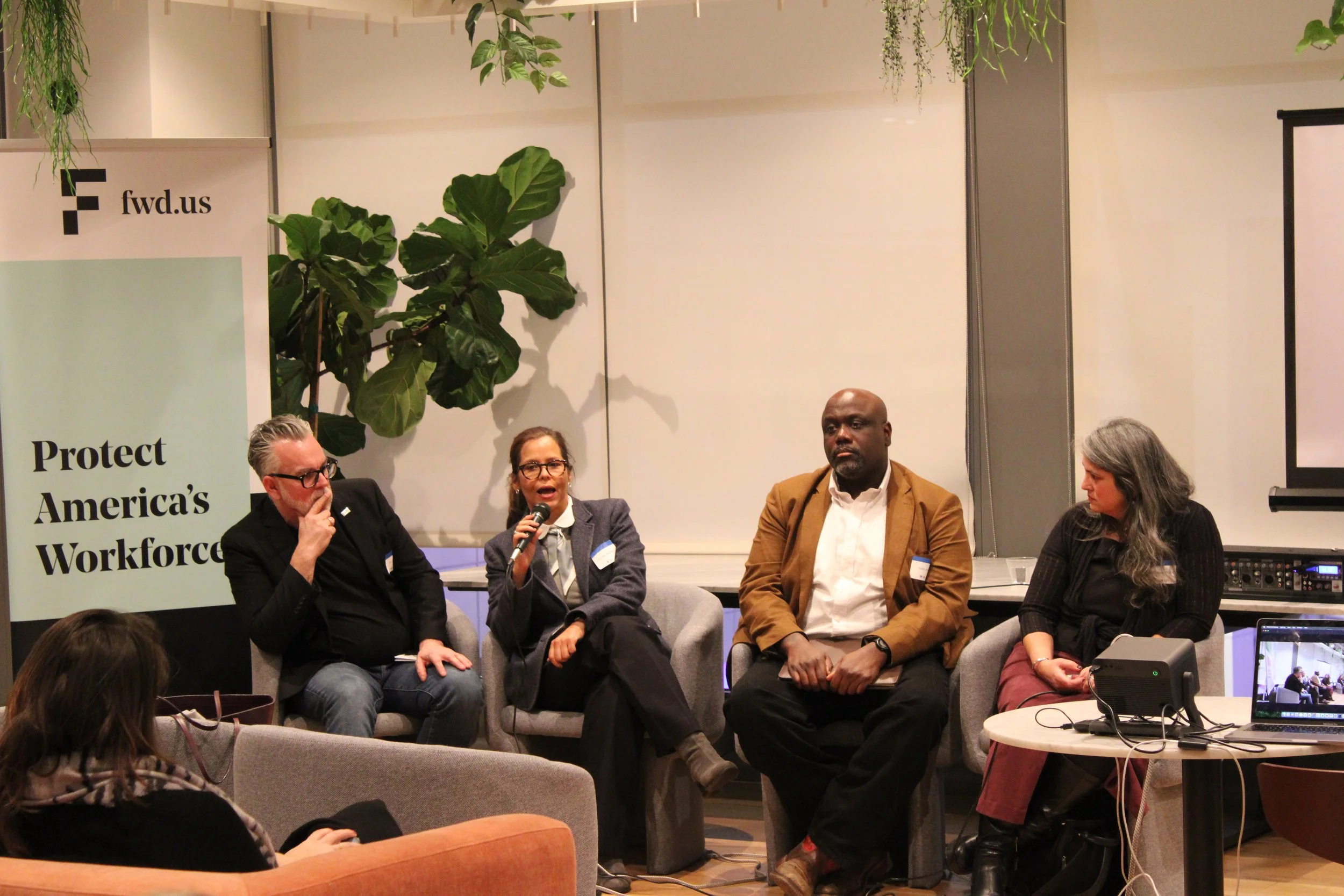
Entrepreneurship is a valid pathway towards wealth creation acording to the panelists. (Photo by Jensen Toussaint / Inti Media)
A 2025 proposal to raise H-1B visa fees to $100,000 adds yet another layer of difficulty toward establishing these kinds of businesses in Philadelphia. “So, what we’re really doing is we are really curtailing the ability of these businesses to be innovative, to hire, to really be the contributors to the economy that we want them to be,” Rodriguez added.
The human cost behind the numbers
The economics are evident, but they don’t tell the entire story.
Elizabeth Jones, chief program officer at The Welcoming Center, described how immigration enforcement and policy instability create not only economic disruption, but also long-term human costs.
For example, if there are policies disrupting families and having people detained or deported, it can impact the jobs fueling our economy and also the actual families.
With labor shortages across industries, many companies are partnering with The Welcoming Center to fill the gaps that can only be filled by the skills and talents many immigrants possess.
“Once you have a workforce that has pretty solid foreign talent … then you have an ecosystem that supports learning for newer people that come in,” said Jones. “It creates a lot of innovation [and] higher productivity because you have a bunch of different people with different experiences and educational backgrounds and languages all working together.”
“Employees have seen a lot of benefit from having a workforce like that,” she continued.
Philadelphia can still make an impact
Philadelphia cannot change federal immigration law on its own, but the city can decide how it will respond.
Panelists suggested steps that could be taken: recruiting international students already authorized to work through optional practical training; investing in credential recognition and upskilling programs; doubling down on neighborhood-based economic development in immigrant communities; and making it fully clear that Philadelphia remains open to global talent.
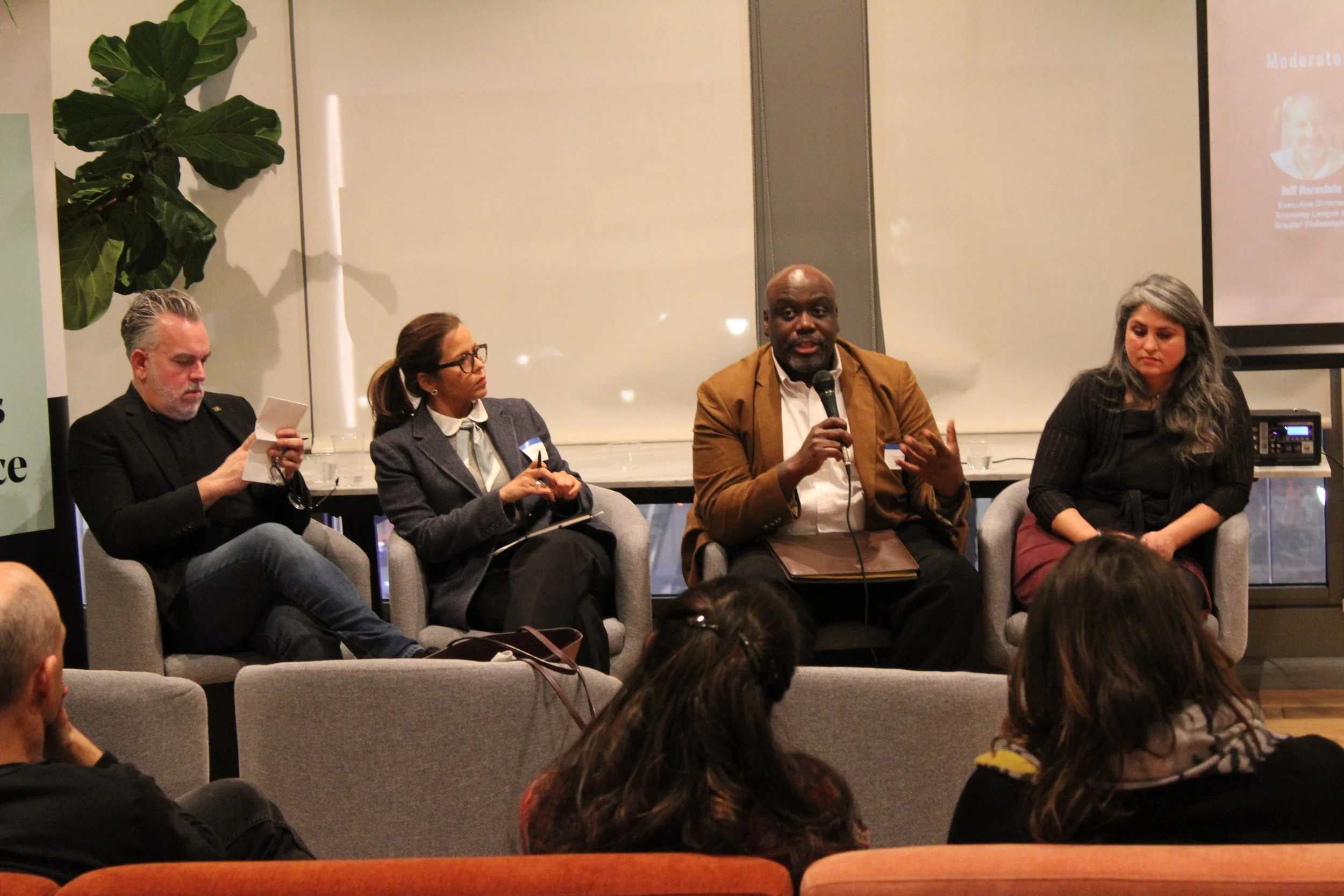
Immigrants not only contribute to Philadelphia's economy; they are a key driver, due to the skills and talents they bring. (Photo by Jensen Toussaint/Inti Media)
“Without immigrants, we have a smaller workforce to drive and support our businesses locally,” said Joinville.
Philadelphia remains in position to leverage and recognize its immigrant communities as catalysts for its economy, culture, and future.