
We spoke with three youth at Juntos about their experiences with ICE and how they’re protecting community.
By DJ Graves. Edited by Nigel Thompson. On November 5, 2026.

David and JM in the Juntos office. (Photo by DJ Graves/ Inti Media.)
Over the course of the first year of the Trump administration, around 8,800 individuals have been arrested at the hands of ICE within Pennsylvania alone. New Jersey and Delaware have seen at least a doubling in arrest numbers over this same period. Recently, ICE increased its daily quota from 1,000 arrests per day to 3,000, threatening communities with more disappearances every day.
Within South Philadelphia, Juntos, a Latine-led non-profit, has been working tirelessly to curb this threat. Recent efforts include protecting sanctuary schools and shutting down the Moshannon Valley Processing Center, Pennsylvania’s largest immigrant detention center (and the largest in the Northeast United States). Inti Media had the opportunity to interview three youth team members of Juntos.
David, a 21-year-old from South Philly, has worked on all of Juntos’ campaigns over his time at the organization. First coming as a youth to Fuerza (a local youth leadership committee), he now works as a sanctuary schools coordinator, ensuring that teachers know the basic procedures in case of an ICE raid.
“They terrorize, you know, dreams, people,” he said. “It is a very encapsulating feeling that they give people … I don't think that people can do the things they want to do freely anymore because of that.” David said vacations were once common for his family, even during Trump’s first term in 2016. “I saw my family travel a lot more than I've ever seen them travel,” he said. “They would go to Chicago, they would go to Miami, they would go to different states.”
Starting in 2016, and up to this current term, mass deportation has become central to the agenda of the president. For David’s family, the travel has since ceased. “Now they don't even want to leave the city,” he said, “it's scary again.”
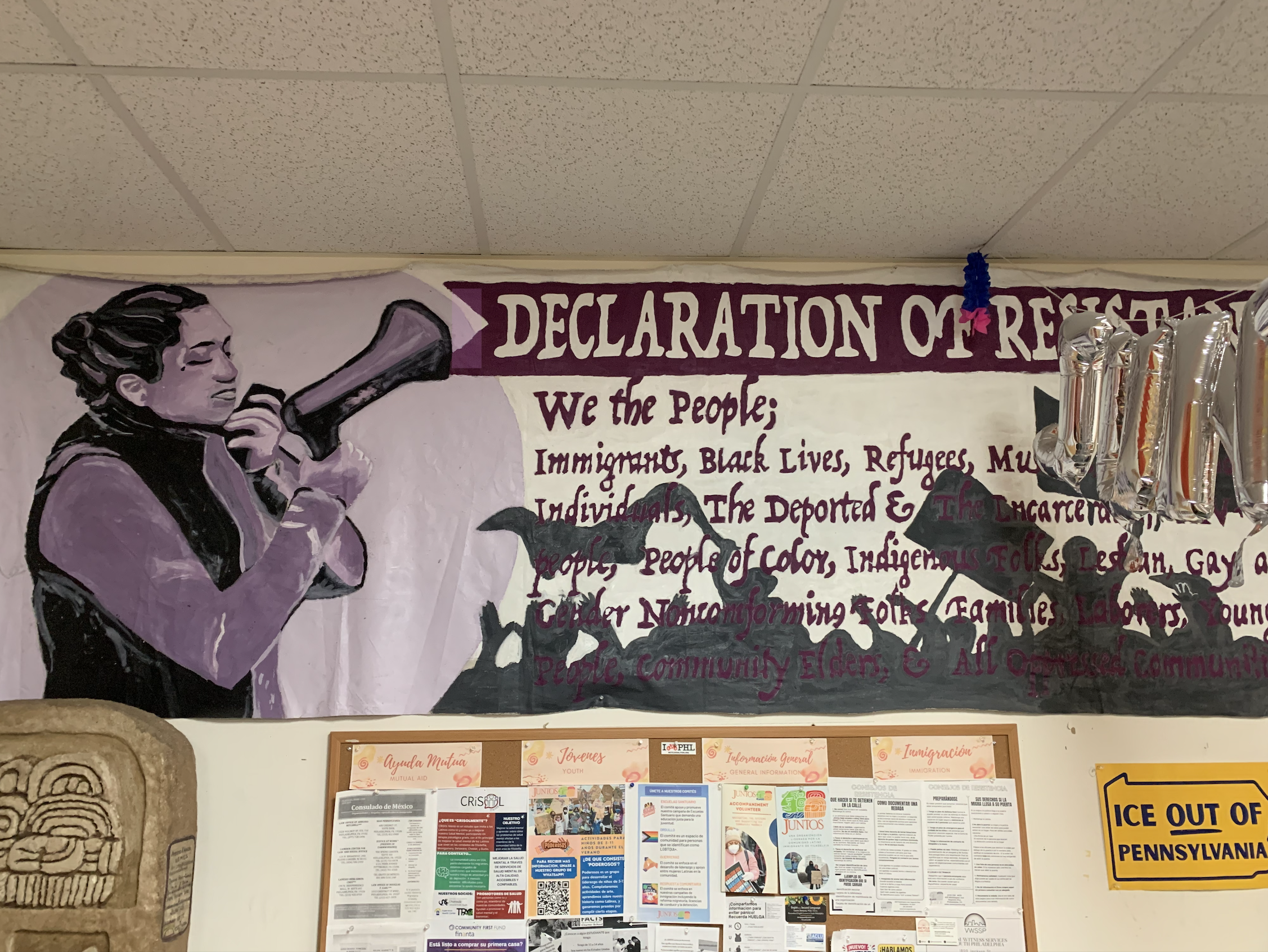
A banner of a Declaration of Resistance held in Juntos’s office. (Photo by DJ Graves/ Inti Media.)
This experience does not exist in a vacuum. ICE arrests and presence at the airport have been steadily spiking since the winter of 2025. Since then, the agency has been targeting those who are suspected to have pending applications for immigration status, green card holders, and those who hold Deferred Action for Certain Childhood Arrivals (DACA) status.
JM, who first got involved with Juntos through her older sister, has witnessed this jump. Over the two years she’s been involved with Juntos, the 14 year-old has seen the ways in which ICE dehumanizes people. “They even shove the kids to separate them from their parents. That's your mom or dad, and a child wouldn't understand what is going on,” she said.
This dehumanization does not end after a kidnapping. According to a report done by the Social Justice Lawyering Clinic (SJLC) on the Moshannon Valley Processing Center, daily lives are defined by “a lack of freedom, choice, safety, and overall wellness.” Detainees are stripped of their personal belongings, placed in brightly colored jumpsuits, and are placed into one of two holding locations. Men are placed in “pods,” sleeping spaces packed with up to eighty other men and essentials like toilet paper are limited. Women are placed in a cell with one other woman, and are kept there for around 22 hours a day. Communication out of these centers seldom occurs.
Another long-time participant and volunteer at Juntos, who wished to be anonymous, has been with the organization since she was six years old. Growing up with Juntos by her side, she has been deeply connected with Latine communities across Philadelphia. Her family remains anxious about a possible attack.
“I saw the other day ... the people who sell tamales outside on Ninth Street, got deported or [taken] into custody, you know,” she said. ICE raids are not only inevitable for Philly youth, but also present throughout their day-to-day lives. Now, the 16-year-old has watched her fellow classmates being taken.
“This boy that I knew, he was in the sixth grade and everything was fine ‘til the end of the year, right when Trump got elected,” she said. “His dad had been deported.”
At school, she struggled to find understanding from her peers about the direness of ICE raids.
“People thought it was funny to make jokes about it. And when I would actually get mad, people would be like, ‘You're being weird. Like you're mad for what?’” she said, “Because y'all don't understand the gravity of the situation. My parents could be taken from me, and that's just the truth. But a lot of people won't understand that because they don't have to worry about it.”
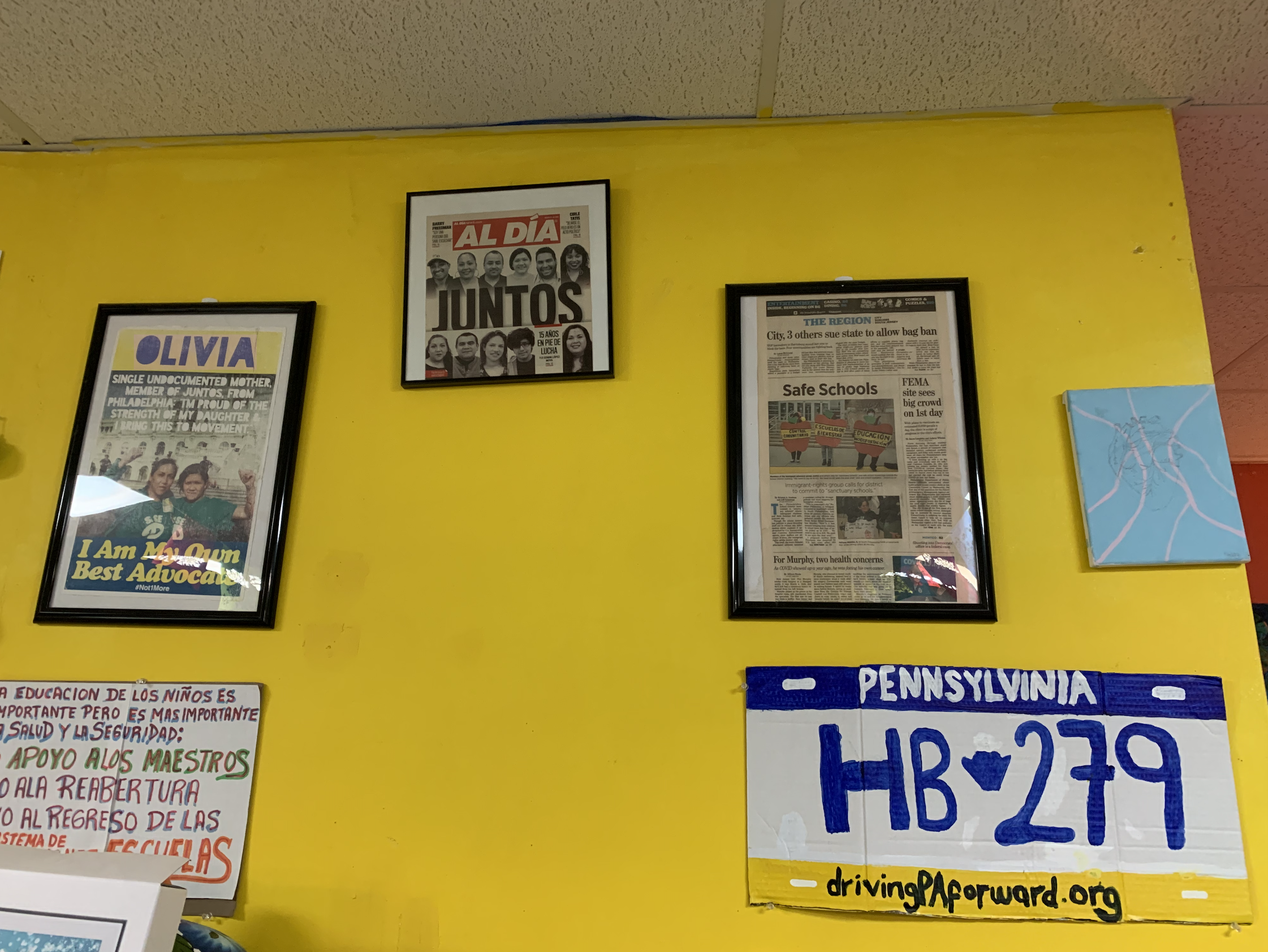
Newspaper clippings framed in the Juntos office. (Photo by DJ Graves/INTI Media)
Despite living in atmospheres of fear and state violence, these youth have found ways to fight back and speak up. JM said she formed a network with close friends and colleagues to check in about ICE.
“I would always want to have updates about my friends, how they are dealing with it, if they're okay or if anything has happened. And we would just talk about how sad it is and if anything has happened to them. We would just keep in touch, keep each other in touch,” she said. For JM, Juntos has supplied a sense of readiness in the case of a raid or kidnapping. She talked about the care available to detainees and their families, such as their tip hotline, personal, and legal support.
Elections also play a crucial role in the movement to end ICE, which the youth factor into their fights. The anonymous youth spoke about the ways in which elections prevent the repetition of harmful eras and actions.
“You not voting leads up to what happens,” she said.
David said the current environment has woken people up to the power of elections. “I definitely feel as though a lot of people have opened their eyes to see what their own actions have caused. A lot of people are going to be willing to vote because I know a lot of people didn't,” he said.
Throughout these times, there remain many messages that still must be shared among the masses. The youth continue to speak amid ICE presence in Philadelphia. There exist many ways to continue to learn and work to end ICE enforcement.
“We have the power to be together, work towards a brighter future, and being separated only gets us so far,” said David.
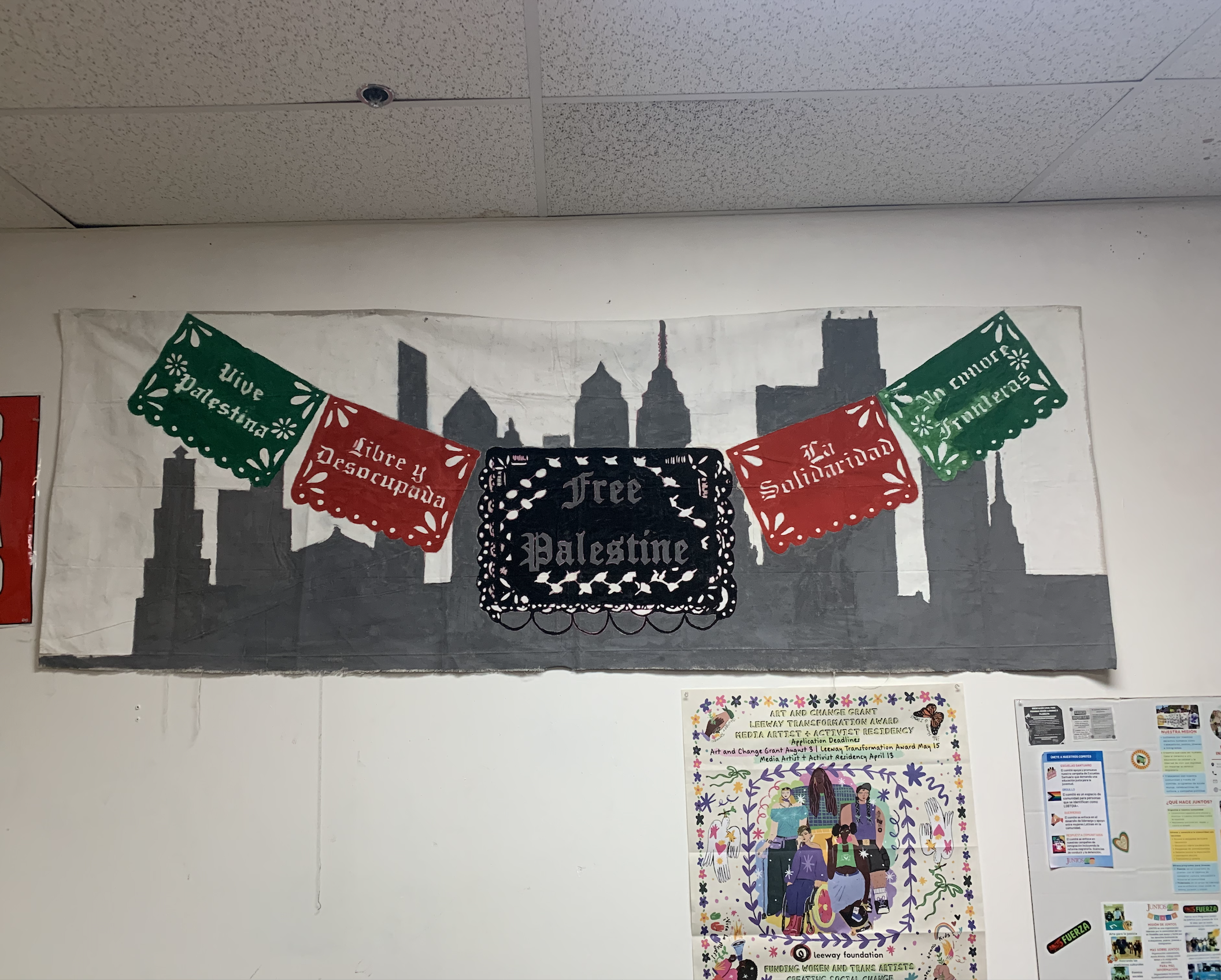
Mexican paper-cutout banner showing solidarity with Palestine in Juntos office. The cut-out text reads “Vive Palestina, libre y desocupada, la solidaridad no conoce fronteras” / “Long live Palestine, free and unoccupied, solidarity knows not borders.” (Photo by DJ Graves/Inti Media)
If you or anyone you know sees ICE activity, please report it using Juntos’s hotline at 814-205-3293. If you would like to support Juntos’s work, please fill out their volunteer interest form located on their website at www.vamosjuntos.org.