
New union pushes city to recognize longtime land stewards who’ve maintained abandoned lots for generations
They also want to push the Land Bank to give stewards a better chance to acquire the lots they’ve maintained over developers.
By Nigel Thompson. Edited by Jensen Toussaint. On June 2, 2026.
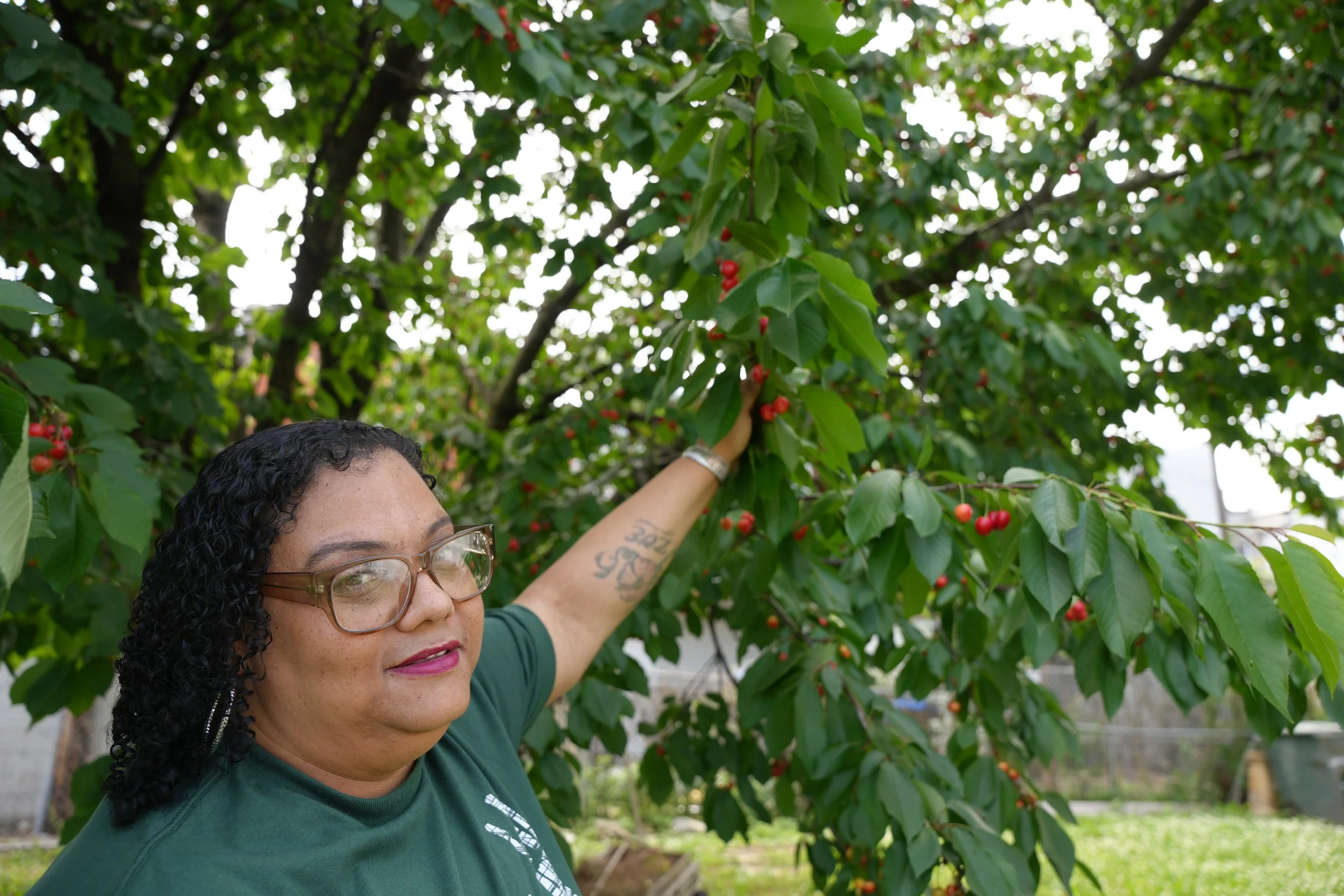
Taussy Valcarcel’s mother has maintained a plot with a cherry tree in Kensington for nearly 30 years. (Photo: Nigel Thompson for Inti Media.)
Philadelphia may be under a drought watch, but the rain that’s hit the city over the last few weeks is bringing cherry-picking season to a block in Kensington a little earlier than usual.
Taussy Valcarcel said even 20 years ago, when her mother planted the cherry tree on the grassy lot next to her house, it produced harvests of the sweet, pitted, red fruit.
“The first year she gave us like 25 cherries,” said Valcarcel. “She’s been giving us fruit since she’s been in the ground.”
Every year, the harvest brings her family back to her mother’s house to join neighbors on the block in the grassy plot around the tree to gather the cherries picked from branches or knocked to the ground by her brother, who she said is often the one scaling a ladder to get to the tree’s higher limbs.
In the end, everyone leaves with bags of cherries that last well into the summer.
“A lot of people say, ‘Why don’t you sell them?’ But that’s not the purpose,” said Valcarcel. “The purpose is to share with the community, share the land.”
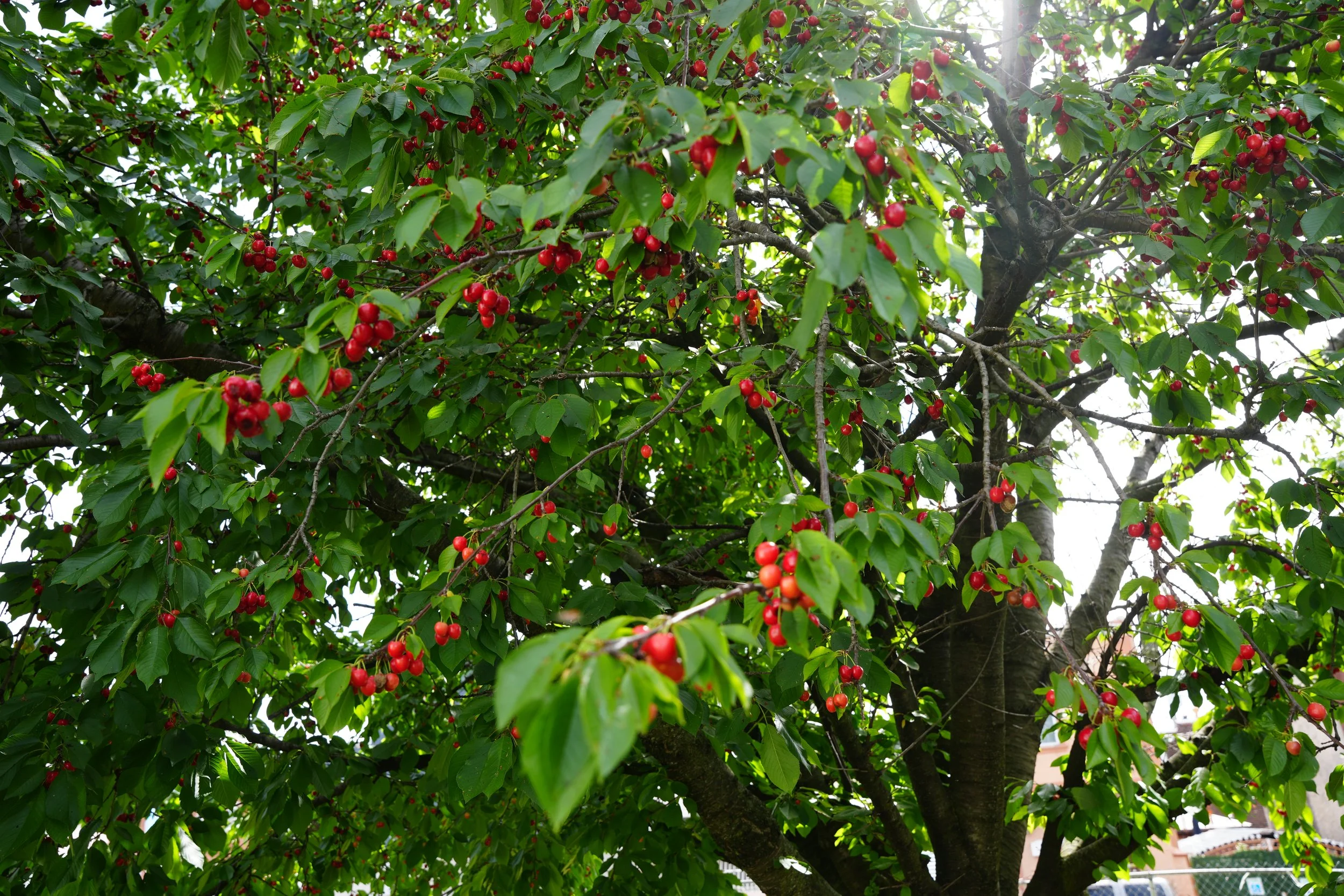
Valcarcel says her mother’s cherry tree has produced fruit all 20 years since she planted it in the ground. (Photo: Nigel Thompson for Inti Media.)
But the land wasn’t always a grassy field with a cherry tree centerpiece. Its current, picturesque state grew out of a labor of love spearheaded by Valcarcel’s mother. When the family first moved to the block in 1998, Valcarcel said the patch of land next to their house was a dumping ground for broken-down cars and tires. It also wasn’t the only lot in the neighborhood to be treated as an afterthought.
“It was very dirty,” she said. “It was very dangerous to be around all these lots.”
Her mother took charge of cleaning them up, starting with the lot next to the family’s house. The cherry tree came a little while later.
“It became a protection area, a place to be safe,” said Valcarcel.
Over the years, the plot hosted several family and community gatherings — from Easter egg hunts to Christmas celebrations. Neighbors would collect discarded aluminum cans and glass bottles on the block to sell and raise money for tools and other resources needed to maintain the land.
Many times her mother also tried going to the city to get ownership of the plot next to her house, only to be met with silence.
“There were no answers,” said Valcarcel.
A union built on years of land battles
It wasn’t until last year that she finally got some, but it wasn’t from the city.
Canvassing her neighborhood were land security organizers with the César Andreu Iglesias Community Garden in Norris Square. They were looking for residents like her, who had maintained plots of land on their block, but did not have ownership of them.
Valcarcel was quick to join their cause, soon to be called the Philadelphia Land Stewards Union. Their goal was to unite land stewards across the city to fight for their rights to the land they maintained.
“After fighting for the land, we realized there were so many people with the same issue,” she said.
Soon, Valcarcel was connected to Richard Kruger-Delgado, one of the land security organizers leading the new Land Stewards Union with Iglesias Garden.
Kruger-Delgado said the union was born out of the past battles over restored vacant lots waged by Iglesias Garden. Its organizers both won and lost lots to developers and learned from each encounter.
“That years of experience led those organizers to the conclusion that residents who stewarded vacant lots needed a membership-based organization that could represent their interests and needs,” said Kruger Delgado. “Often these folks are not represented by the mainstream urban agriculture-urban community ecosystem because their lots may not be gardens.”
He said the practice of maintaining side lots and plots of land on blocks has existed informally in Philadelphia communities for decades. A lot of them can be found in North Philadelphia, especially in and around Kensington, where residents responded to the city’s disinvestment by pouring their own resources into maintaining and beautifying the land rather than seeing the plots become sores of crime and drug abuse.
That’s where a lot of the union’s founding members — like Valcarcel — are based, but Kruger-Delgado said membership has expanded to West and Northwest Philadelphia, respectively.
Since the union’s organizing started in October 2025, Kruger-Delgado said membership is now at more than a hundred and likely to keep rising.
A first step to reforming the Land Bank
In April, the union officially launched its first campaign as hundreds of residents crowded the Hartranft Community Center to sound off about land rights and their own difficulties navigating the city’s Land Bank to get a chance at owning the plots they steward. It was also attended by Councilmember Quetcy Lozada and members of Mayor Cherelle Parker’s Administration. Both expressed support for the Land Steward Union’s goals at the meeting.
Lozada and Councilmember Kendra Brooks sponsored a resolution in City Council to recognize the work of the Land Stewards Union and work towards more transparency around land acquisition in the city. It passed on June 6.
“We see this as a first step, and a winnable step to educating the power holders, the public, getting that recognition,” said Kruger-Delgado, “and then using that as a foundation to push for further reform.”
Some of that reform is getting the Land Bank to do things that it can already accomplish. Land Security Organizer Ryan Gittler-Muñiz said the city’s system for disposing of excess land is progressive on paper, but “dysfunctional in practice.”
“It’s been a really confusing process for residents to figure out: ‘Ok, I have city land I take care of, how do I get it?’” he said.
Most of the time, Gittler-Muñiz said stewards don’t hear anything when they reach out to the Land Bank. Demanding more communication and transparency is a major goal — especially around knowing when and to whom land gets sold.
“I think there’s this broader need for community control of land,” said Gittler-Muñiz. “Folks just want a say in what happens in their neighborhoods. They want a say in what happens to this vacant land, whether it stays green space or becomes affordable housing.”
Debbie Johnson said she heard nothing over the years, no matter how many times she reached out about acquiring the lot next to her home in Nicetown. She had stewarded it for 40 years after rescuing the plot from disrepair during the crack epidemic. It had a rose garden to honor lost loved ones, a vegetable garden, and hosted countless fish fries, barbecues, and every kind of community and family gathering over the years.
All of it came crumbling down in November of last year when she came home to someone photographing the lot. When she asked the person about their intentions, they told her they were the new owner of the plot. The original owner had passed months earlier, and Johnson said the city acted quickly to find the owner’s daughter for her to purchase the land. The daughter told Johnson she planned to sell the lot to a housing developer.
“From August to November, they moved fast and found it, but for the 40 years that I’ve been taking care of it, nothing,” Johnson said. “I was distraught. I cried. It was devastating.”
Not long after, she immersed herself in the work of the Land Stewards Union.
“I wanted to still try to help somebody else. To keep this from happening to somebody else,” said Johnson.
At one time, the Land Bank had an interest form to fill out for residents wanting to purchase lots and promised a response within 30 days. That form of inquiry was retired during the pandemic, leaving many residents without a response long after the 30-day deadline.
Today, there are numerous Land Bank applications for residents to consider when trying to obtain land. They cover inquiries for side lots, community gardens, affordable housing development, business expansion, and general community use.
Further policy change
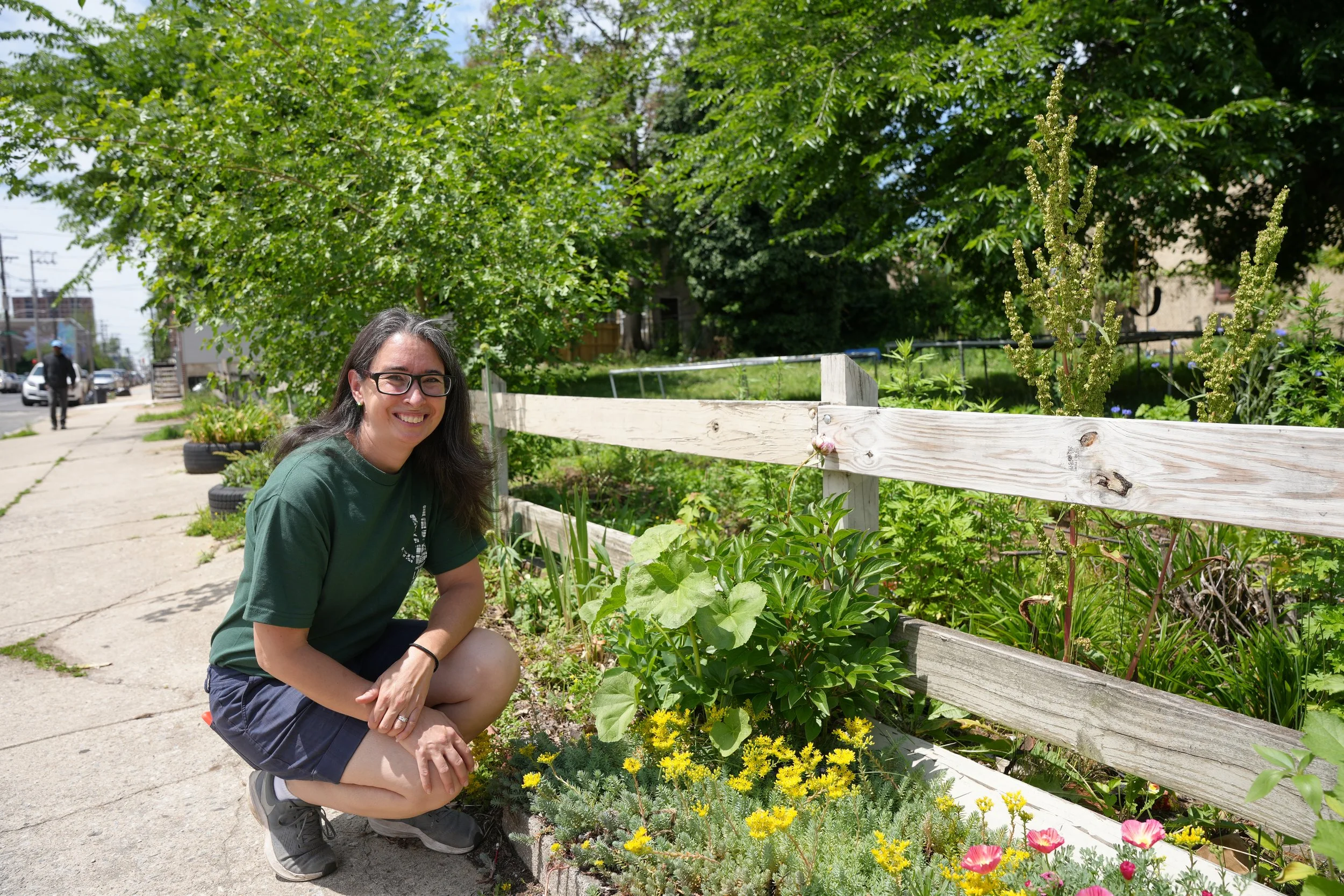
Christina Saxton poses with one of the many flower beds that line the perimeter of her maintained plot of land in North Philadelphia. (Photo: Nigel Thompson for Inti Media.)
When it comes to eventual policy change, members of the Land Stewards Union pointed to other cities like Detroit and Chicago that give neighbors the first chance to acquire plots in their communities before developers, and also open land acquisition to stewards who don’t live directly next to the plots they want to purchase.
Christina Saxton, who’s maintained a large plot in North Philadelphia since she moved to the block in 2009, pointed to a policy in Chicago that allows residents who live within 300 feet of a plot to acquire the land. If that existed in Philly, Saxton said she’d be able to acquire a portion of the plot she maintains.
“I’ve been using this space for 17 years. I want to continue using it for 17 years in just the way I have, as a blessing for the community. As a place of life and creativity,” she said.
The large, grassy parcel is shaded by two massive trees. The perimeter is made up of raised flowerbeds. A moving neighbor also donated two trampolines to the space. It has become a haven over time where elementary school kids in the neighborhood can play and experience nature.
“Parents allow them to come because it’s a place that is green versus a concrete playground. They also don’t have to pass big, busy streets to get here,” said Saxton.
There are also rules when entering the space. All visiting children must pick up five pieces of trash before they can play on the trampolines or swings that hang from the trees.
“Here, they’re learning responsibility to take care of the things that they’re using,” said Saxton.
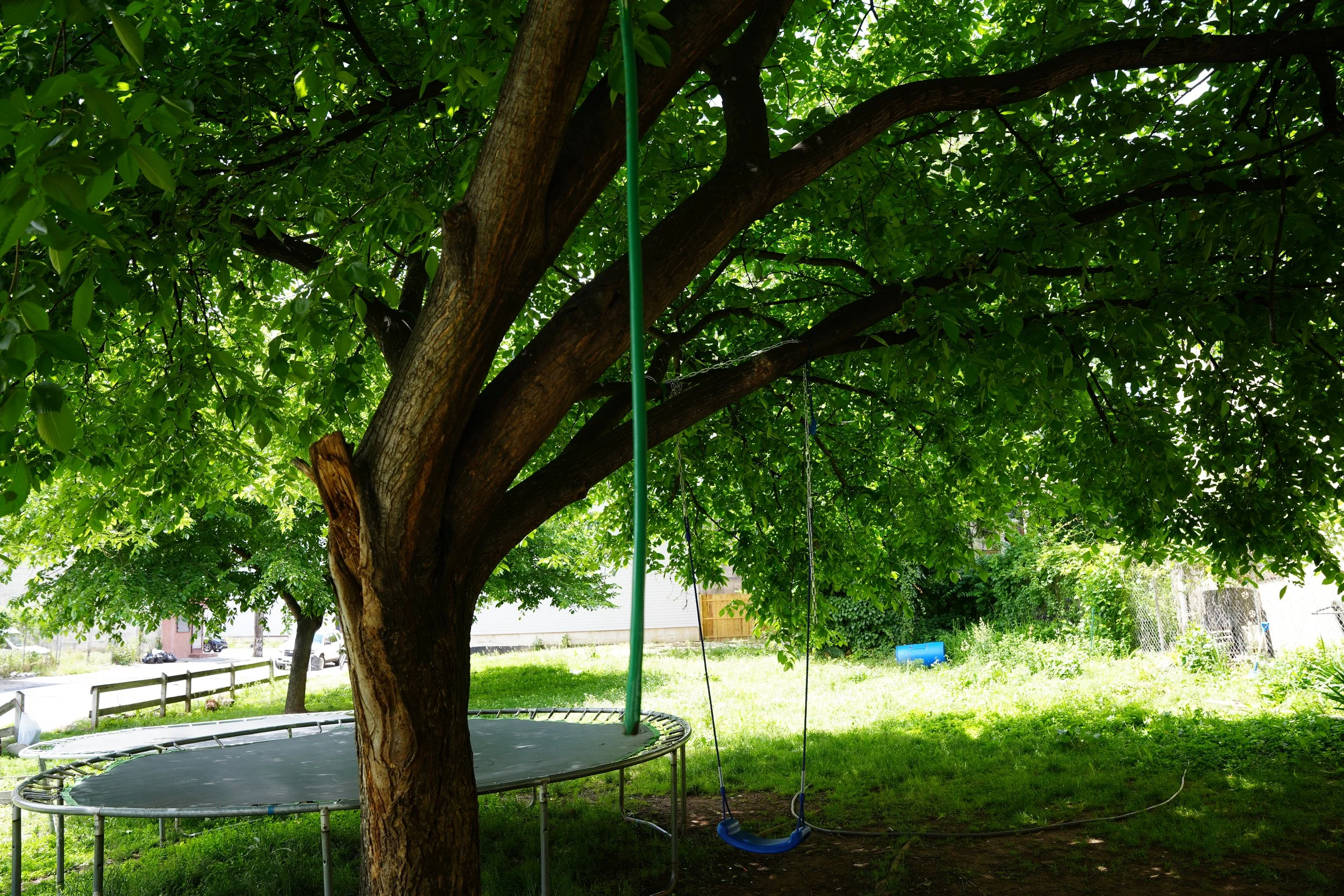
Saxton’s plot is shaded by two big trees, and a place for neighborhood children to play and connect with nature. (Photo: Nigel Thompson for Inti Media.)
In 2020, Saxton said she tried contacting the Land Bank about acquiring the lot, but heard nothing back. She’s also gotten signatures multiple times from neighbors in support of the plot, but said she only started seeing progress when she linked up with the Land Stewards Union.
“Before I would just stalemate,” said Saxton.
She said she also started seeing herself as part of the citywide story of land stewards fighting for a chance to keep the plots they’ve long maintained.
“It’s a gift we’re bringing to the neighborhood,” said Saxton. “All we want is the chance to continue to do that.”
Greener plots for a safer, cleaner, greener Philly
Gloria ‘Smooches’ Cartagena Hart equates maintained green spaces in the city, like her Butterfly Garden in Kensington, to “a diamond in the rough.”
“It’s somewhere you can escape to,” she said. “You forget where you’re at for the moment, especially when you have this greenery.”
She hopes more people can join the growing Land Stewards Union, and that it can get more support in its efforts from the Mayor and City Council.
“She is for a greener, safer, cleaner Philadelphia, and that’s what we’re doing,” said Cartagena Hart. “All we want is that respect and acknowledge us that we are people in the community who care about where they live.”